A sales team misses target for the third quarter in a row, and the response is often predictable: book a training day, bring everyone into a room, and hope new techniques fix old habits. Sometimes that works. Often, it does not. The real question in sales coaching vs sales training is not which one sounds more impressive. It is which one solves the performance problem you actually have.
For business leaders, HR teams, and sales managers, this distinction matters because poor diagnosis wastes time, budget, and momentum. If your team lacks a clear process, training is usually the answer. If they know the process but fail to apply it consistently under pressure, coaching is usually the stronger lever. High-performing organisations know the difference and use both deliberately.
Sales coaching vs sales training: what is the difference?
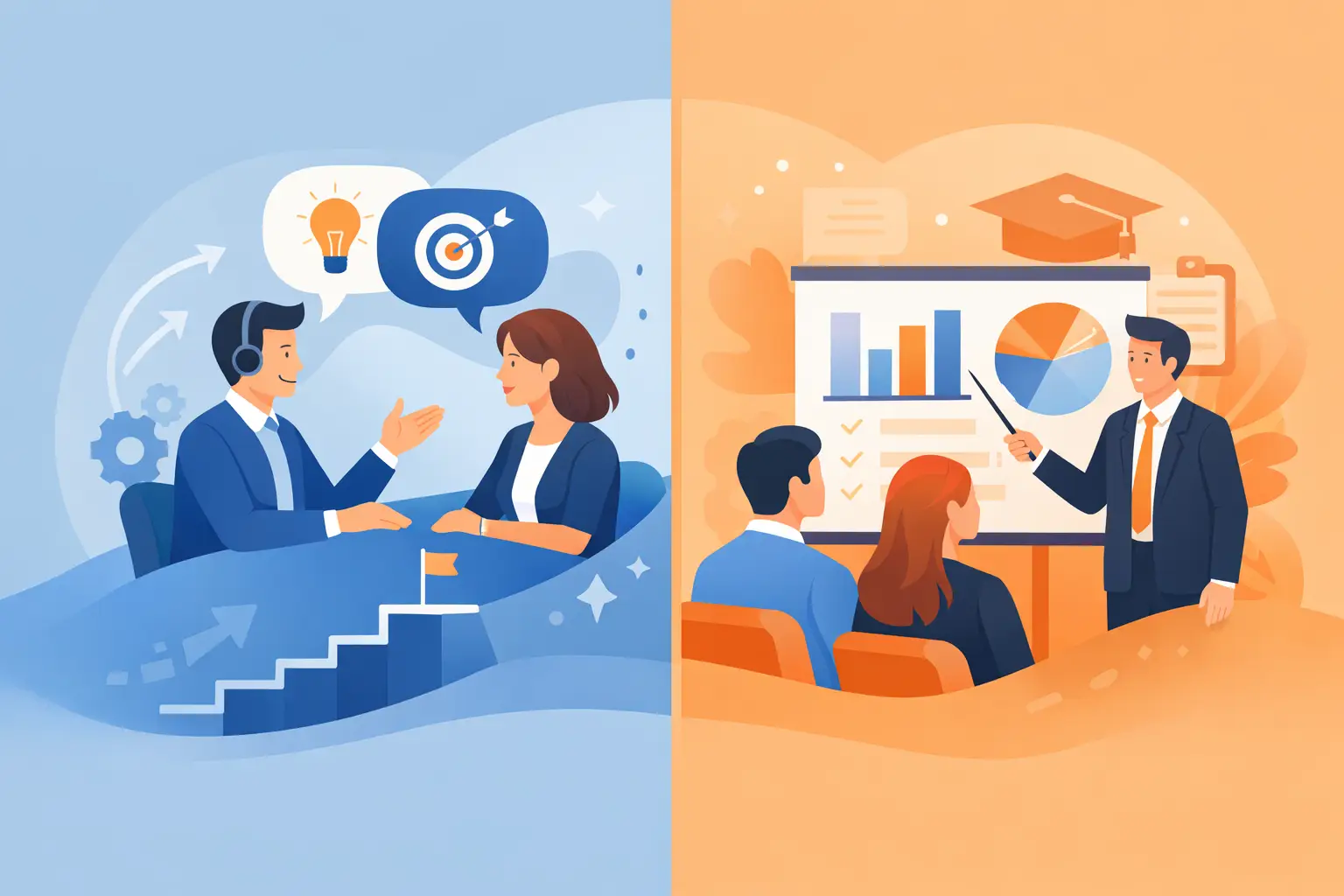
Sales training is structured instruction. It is designed to build knowledge, introduce frameworks, sharpen techniques, and create a shared standard across a team. It often happens in workshops, group sessions, onboarding programmes, or focused capability development initiatives. Training answers questions such as: what should our sales process look like, how do we handle objections, how do we qualify opportunities properly, and how should we communicate value?
Sales coaching is different. It is ongoing, personalised, and performance-focused. Rather than teaching the whole team the same model at the same time, coaching helps an individual salesperson improve how they execute in real situations. Coaching tends to involve observation, feedback, questioning, accountability, and targeted practice. It answers a different set of questions: why is this person struggling to convert, where are they losing confidence, what behaviour is holding results back, and what needs to change this week?
Training builds capability at scale. Coaching improves execution person by person. Training tells people what good looks like. Coaching helps them perform at that standard when the stakes are real.
When sales training is the right investment
Sales training is most valuable when your business needs consistency, clarity, and a stronger commercial foundation. If your team uses different language with clients, follows different stages in the pipeline, or relies too heavily on instinct, training creates alignment. It gives people a common method and a common vocabulary.
It is especially useful during onboarding, after a strategic shift, when entering a new market, or when a sales team has grown faster than its standards. In those moments, the issue is not simply individual performance. The issue is that the team needs a better operating model.
Training also works well when the sales challenge is visible across a group. If several people struggle with questioning, negotiation, value articulation, or closing, you are likely dealing with a capability gap rather than a one-off performance issue. A well-designed programme can raise the baseline quickly.
That said, training has limits. People can leave a session energised, take excellent notes, and still return to old habits by Friday. Knowledge transfer is not behaviour change. If training is treated as a one-off event rather than part of a wider performance system, the impact fades.
When sales coaching delivers more value
Sales coaching is the better choice when the knowledge exists but the execution is inconsistent. This is common in experienced teams. Reps may understand the product, the process, and the expected behaviours, yet still struggle in live conversations. They may avoid asking tougher questions, discount too early, speak too much in presentations, or fail to challenge a client with confidence.
Coaching addresses the performance gap between knowing and doing. It is practical because it works with reality. A manager reviews calls, observes meetings, identifies patterns, and helps the salesperson adjust. That feedback loop matters because selling is not just technical. It is psychological. Confidence, judgement, resilience, and communication style all affect results.
This is where many organisations underinvest. They provide training but do not equip managers to coach. Then they wonder why capability improvements do not stick. If first-line sales managers are only inspecting numbers and not coaching behaviour, much of the value of training is lost.
Coaching is also powerful for higher performers. Average reps may need more structure. Strong reps often need refinement. Coaching helps them sharpen commercial judgement, navigate complex stakeholders, and improve high-stakes communication in larger opportunities.
Why the best organisations use both
The real choice is rarely sales coaching vs sales training as an either-or decision. In most cases, the best answer is sequence and combination.
Training should establish the standard. Coaching should reinforce it in the field. Training gives your sales team the model, language, and method. Coaching turns that method into daily behaviour. Without training, coaching can become vague and subjective. Without coaching, training can remain theoretical.
Think of training as the architecture and coaching as the day-to-day discipline that makes the structure hold. One creates understanding. The other creates consistency. Together, they create measurable improvement.
For example, a business rolling out a consultative sales process may begin with formal training to define each stage, improve questioning, and tighten value communication. After that, managers or external coaches can support individual reps through deal reviews, call debriefs, role-play, and targeted feedback. That is how capability becomes revenue.
How to decide what your team needs now
If you are deciding where to invest, start with diagnosis rather than preference. Ask what is truly getting in the way of performance.
If your team lacks a clear process, uses weak messaging, or shows the same skill gap across multiple people, training should come first. If the process already exists but adoption is patchy, conversion rates vary widely, or certain reps repeatedly fall short despite understanding what to do, coaching is likely the priority.
It also depends on seniority. Newer salespeople often need more formal instruction because they are still building fundamentals. Experienced sellers may benefit more from coaching because their challenges are usually more specific and behavioural. Senior business development professionals, account directors, and commercial leaders often need sophisticated coaching around influence, stakeholder management, and executive-level communication.
One more factor matters: manager capability. If your sales managers cannot coach well, an investment in coaching may underperform unless you first develop them. Too many organisations promote strong salespeople into management and assume coaching will come naturally. It does not. Coaching is a distinct leadership skill.
Common mistakes in the sales coaching vs sales training debate
The first mistake is using training as a rescue plan for every problem. Training is visible, easy to schedule, and feels productive. But if the issue is inconsistent management, low accountability, or weak confidence in live selling situations, training alone will not fix it.
The second mistake is calling something coaching when it is really inspection. Asking for forecast updates is not coaching. Reviewing pipeline numbers is not coaching. Coaching requires observation, reflection, challenge, and guidance that improves behaviour.
The third mistake is ignoring communication. Sales performance is rarely just about process. It is about how well your people ask questions, listen, frame value, handle resistance, and lead commercial conversations with credibility. Communication is not an add-on to sales effectiveness. It sits at the centre of it.
That is why organisations that want stronger commercial results often get more value from development partners who understand both performance psychology and business communication. When sellers communicate with greater clarity and authority, they build trust faster and move opportunities forward more effectively.
What better looks like
A stronger sales organisation does not rely on occasional inspiration. It builds repeatable performance. That means training people properly, coaching them consistently, and holding a high standard for how they communicate with prospects and clients.
If you want a quick fix, the distinction between coaching and training may feel frustrating. If you want results that last, it is liberating. You can stop buying generic solutions and start investing in the right intervention for the right problem.
At Power In Excellence, that belief sits at the heart of effective sales development: excellence is not accidental, and communication is not secondary to performance. It is one of the clearest drivers of it.
The best next step is not to ask whether coaching or training is better in general. Ask where your team is losing momentum, confidence, or consistency, and build from there. When the diagnosis is right, improvement stops being hopeful and starts becoming predictable.